
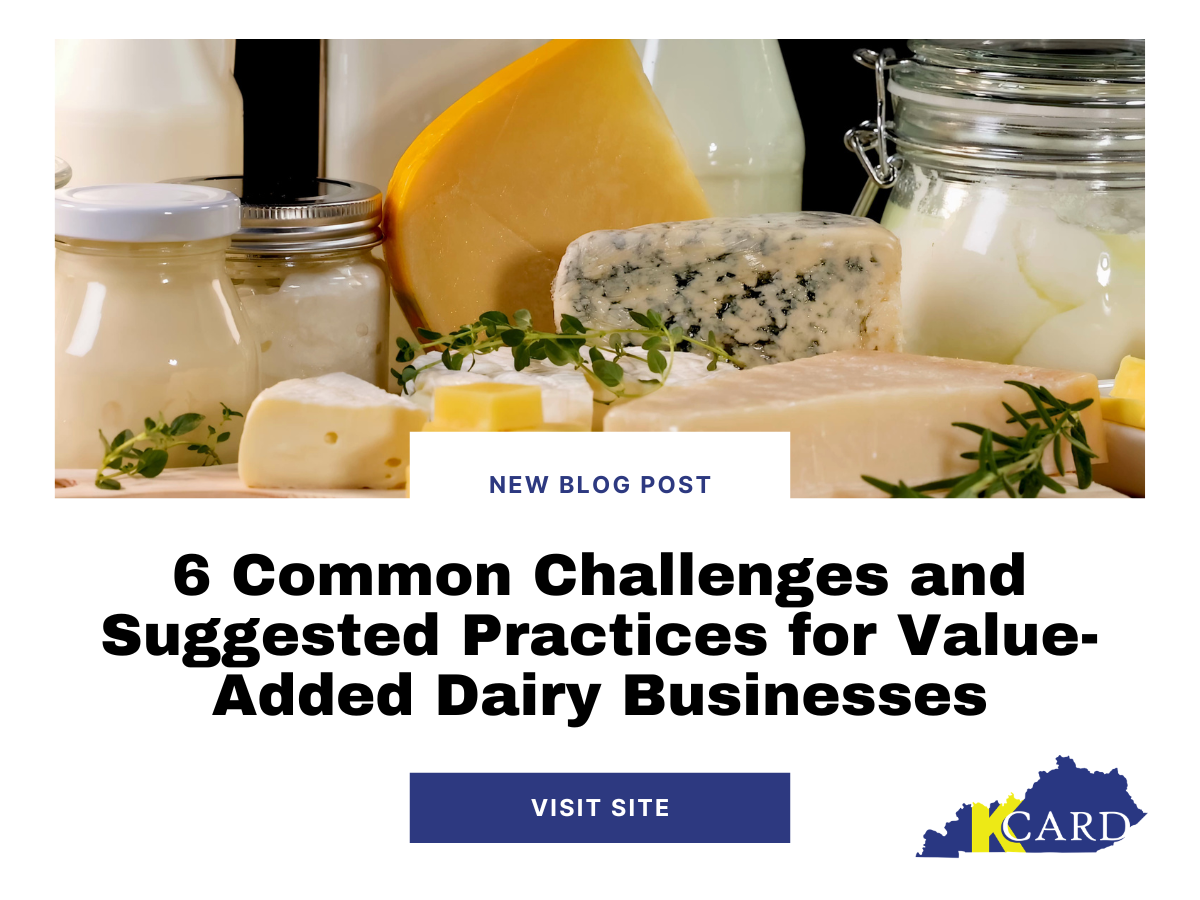
Value-added dairy businesses create powerful opportunities for farms to diversify income, strengthen margins, and build direct relationships with customers. But as operations grow, so do the management demands behind the scenes.
Since 2022, KCARD has conducted 10 in-depth business evaluations of established dairy processors in Kentucky and the Southeast, and several consistent operational themes have emerged from these evaluations. While every value-added dairy is unique, these six areas frequently influence efficiency, profitability, and long-term sustainability.
1. Employee Communication & Training
As teams grow, informal training systems often don’t grow with them.
In several businesses, onboarding was inconsistent, roles were unclear, or employees weren’t fully confident explaining the farm’s history and products. In a value-added setting, where customer experience is part of the product, that matters.
Clear expectations, defined reporting structures, and intentional training programs help create smoother operations and stronger brand representation.
2. Financial Monitoring & Inventory Awareness
Many businesses were busy producing and selling, but didn’t always have timely, easily accessible financial or inventory data.
Without consistent tracking of production records, inventory levels, and financial performance, it becomes difficult to answer critical questions:
Which products are most profitable?
Where are margins shrinking?
Are ingredient costs aligned with pricing?
Even small recordkeeping gaps can quietly affect the bottom line.
3. Quality Control & Process Consistency
In a value-added dairy, consistency builds trust.
Small recipe variations between employees or shifts may seem minor in the moment, but over time they can impact both product quality and cost of goods sold. When production processes aren’t clearly documented or reinforced, inconsistency becomes more likely.
Written recipes, accessible standard operating procedures, and periodic retraining can significantly strengthen product reliability.
4. Business Vision & Long-Term Planning
Daily operations often demand immediate attention, leaving little time for strategic planning.
However, businesses without a shared written vision or long-term direction may experience misaligned priorities, stalled growth, or tension among leadership. Planning for transitions, whether expansion or succession, becomes especially important as operations mature.
Intentional planning provides clarity when tough decisions arise.
5. Fluid Milk Supply & Quality
A dependable milk supply is the foundation of any dairy processing operation.
Concerns around milk quality, production volume, or reliance on a single supplier can introduce risk. For dairies with on-farm processing, herd performance directly influences both product consistency and profitability. For businesses sourcing milk externally, communication and defined quality standards become critical.
Strengthening supply reliability protects both margins and brand reputation.
6. Target Marketing & Customer Focus
Most businesses understand that marketing is important, but fewer operate with a clearly defined target customer in mind.
Retail and wholesale audiences often require different messaging, pricing structures, and relationship management strategies. Without clarity around who the business is trying to reach, and what those customers truly value, marketing efforts can become scattered.
Gathering customer insights and aligning strategy accordingly can create measurable impact.
Managing for Long-Term Success
These challenges are common, not because businesses are failing, but because growth naturally adds complexity.
The good news? Each of these areas presents an opportunity. Strengthening internal systems, improving communication, documenting processes, and clarifying strategies can position value-added dairy operations for greater resilience and profitability. KCARD and other resource providers such as the UT Center for Profitable Agriculture are available to value-added dairy and other agriculture-based operations to address these challenges.
For those interested in exploring these findings and recommendations more deeply, additional insights and suggested practices are available in the complete resource.
KCARD provides business development support to value-added dairy businesses, including assistance with planning, operations, and growth strategy. Contact us at kcard@kcard.info or 859-550-3972 to get started!